
Funerary Mask Made of Jade Mosaic
01 Photograph Gallery

02 Object Information
- Description
Description
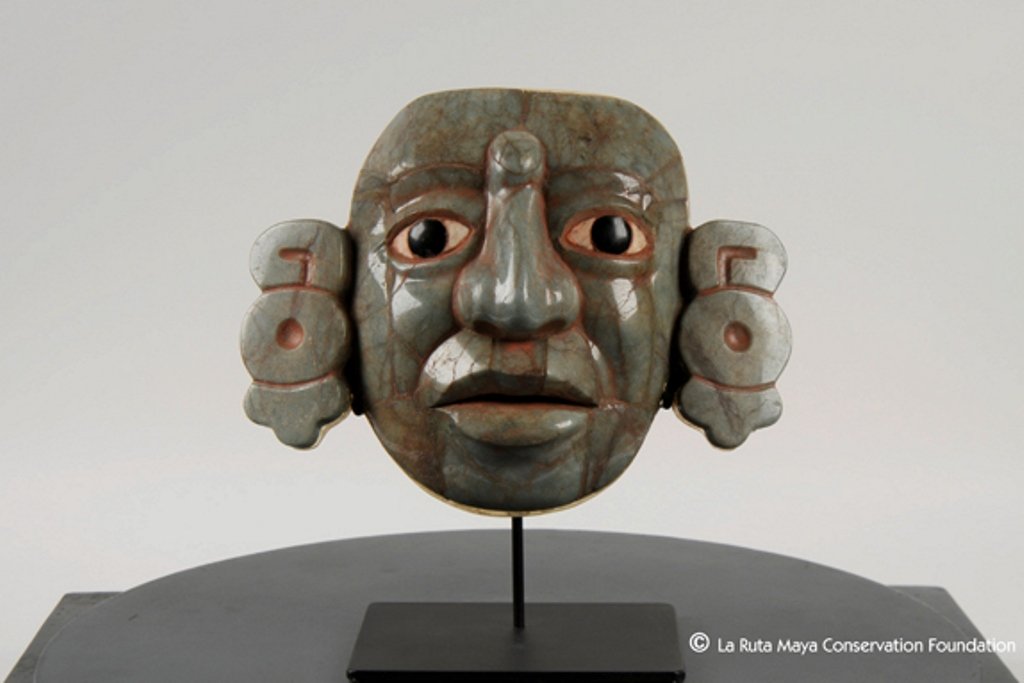
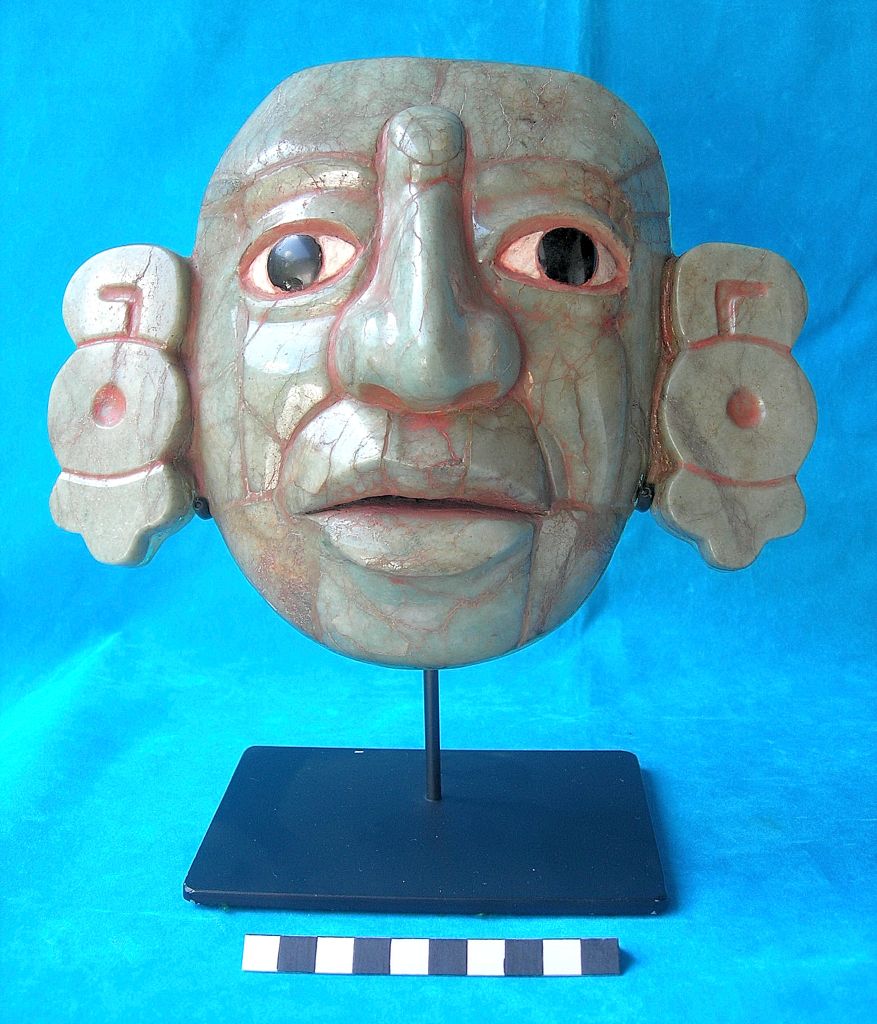
Mask composed of jade fragments assembled using mosaic technique, with shell and obsidian inlays in the eyes. The face represents a figure wearing round earspools, decorated with a scroll at the top and a trilobed element at the base. The open eyes, broad nose, and full lips stand out—features that evoke a solemn and possibly idealized presence. Incised details are filled with hematite, accentuating the facial contours.
The mask is mounted on clear acrylic for preservation and display; however, although pieces of Pre-Columbian origin were used, not all fragments appear to correspond to the piece.
Technical Report on Authenticity and Manufacturing
The mask is accompanied by documentation issued by the ORENDA laboratory (Investigation and Analysis of Artifacts and Antiquities; PO BOX 322, Santa Fe, NM 87504, USA), certifying the authenticity of the jade and its pre-Hispanic manufacturing processes. The analysis identified small deposits of soil, charcoal, and copal, along with other elements consistent with archaeological samples dated between AD 450 and 950. It is important to note that this comparison does not determine the exact date of manufacture, but rather establishes correlations with other examples from the same type and period.
According to the report, the mask shows no evidence of modern tools or residues from contemporary abrasives. All traces of manufacture correspond exclusively to traditional techniques, including pecking, cutting, grooving, carving, hole drilling with bow drill, manual helical drilling, and abrasion using stone.
Restoration and provenance certificate
There is a certificate dated December 6, 2006, stating that for its restoration, “original pieces from other archaeological sites were used, but of the type that would have been used in ancient times for the same purpose.”
- Period
- CLASSIC (150/200 A.D.-900 A.D.)
- Provenance
- Maya Lowlands
- Medium / Material
- Hematite, Jade / Jadeite, Obsidian, Shell
- Technique
- Attrition, Grooving, Incised, Inlaid, percussion, Polished, Worked
- Dimensions
Height: 18.2 cm
Maximum Width: 24.3 cm
Maximum Length: 7.2 cm
03 References and Exhibitions
- References to similar objects
Jadeite Mosaic Masks in Classic Maya Culture (Dorie Reents-Budet and Sofía Paredes Maury, 2025)
Jadeite mosaic masks were worn exclusively by the highest-ranking members of Classic Maya society (250–850 CE). These masks had ceremonial and symbolic functions: some were placed in royal burials, while others were worn as part of elaborate belts or pectorals by both men and women. Pectoral masks were usually smaller than belt masks.
These masks often represented deities or revered ancestors, serving as powerful symbols of divine authority. In a world where rulers constantly had to reaffirm their legitimacy—both among rival city-states and in the spiritual realm—these adornments played a key role in expressing their sacred connection to the gods.
Crafted by highly skilled artisans, the masks were made from polished jadeite—especially the finest green varieties sourced from southern Guatemala. Other materials like obsidian, conch shell, and the vivid red Spondylus shell from the Pacific were used to highlight features such as eyes and lips.
The mosaic pieces were originally mounted on wood or a papier-mâché-like base, which rarely survives the humid conditions of the Maya lowlands. As a result, many masks are found as scattered fragments that require careful restoration to reconstruct their original form.
Jadeite was not only prized for its beauty and rarity but also for its deep spiritual meaning. In many Mayan languages, the word yax refers to both green and blue—colors associated with water, fertility, and maize, the sacred crop that sustained life. These associations made jadeite the most precious material in ancient Mesoamerica.
As royal emblems, jadeite masks symbolized the ruler’s divine connection to the Maize God, reinforcing their power and legitimacy through cosmological beliefs.
To read more:
Gallegos Gómora, Miriam Judith y Ricardo Armijo Torres. 2004. “Rostros Mayas de Jade (mini-guía)”. CONACULTA-INAH. Instituto Nacional de Antropología e Historia, Mexico. (documento en PDF)
García Vierna, Valeria A. 2004. “¿Máscaras para la Vida o para la Muerte? Una reflexión sobre la función de las máscaras de mosaico de jadeíta en el Área Maya”. Texto presentado como finalista para el Premio Palenque publicado en la Memoria de la IV Mesa Redonda de Palenque. INAH-CNCA. 70-86 pp.
- Exhibitions
1. While it was part of a collection in Switzerland for 20 years, it was exhibited in a “Maya exhibition” at Palazzo Grassi, Venice, Italy.
[Probably it was the one shown in 1998 titled “I Maya,” one of the most comprehensive showcases of this pre-Columbian civilization. The exhibition featured around 600 pieces from 11 countries across the Americas and Europe, including codices, ceramics, sculptures, paintings, and ritual objects. The show was organized by the FIAT Group, which at the time managed Palazzo Grassi as an exhibition center. The official exhibition catalog, titled “I Maya,” was edited by Peter Schmidt, Mercedes de la Garza, and Enrique Nalda, and contains over 600 pages with color images and specialized essays]
2. On loan at Museo Miraflores, Guatemala City (From 2009 until September 26, 2018)
3. “THE WORLD TREE” (24th Paiz Art Biennial) within the “SELF-HYBRIDATIONS” exhibition by ORLAN. Spanish Cooperation Training Center, Antigua Guatemala (November 5, 2025 to February 15, 2026). General Curator: Eugenio Viola.
- Publications
Aon, Frank. 14 de agosto de 2006. “Analytical Report on Object #209146STL”. ORENDA Investigation and Analysis of Artifacts and Antiquities laboratories. PO BOX 322 Santa Fe, NM 87504, USA.
Stoetzer, Robert. December 6, 2006. “Certificate of Restoration and Provenance.” Stoetzer Inc. Miami, Florida.


