
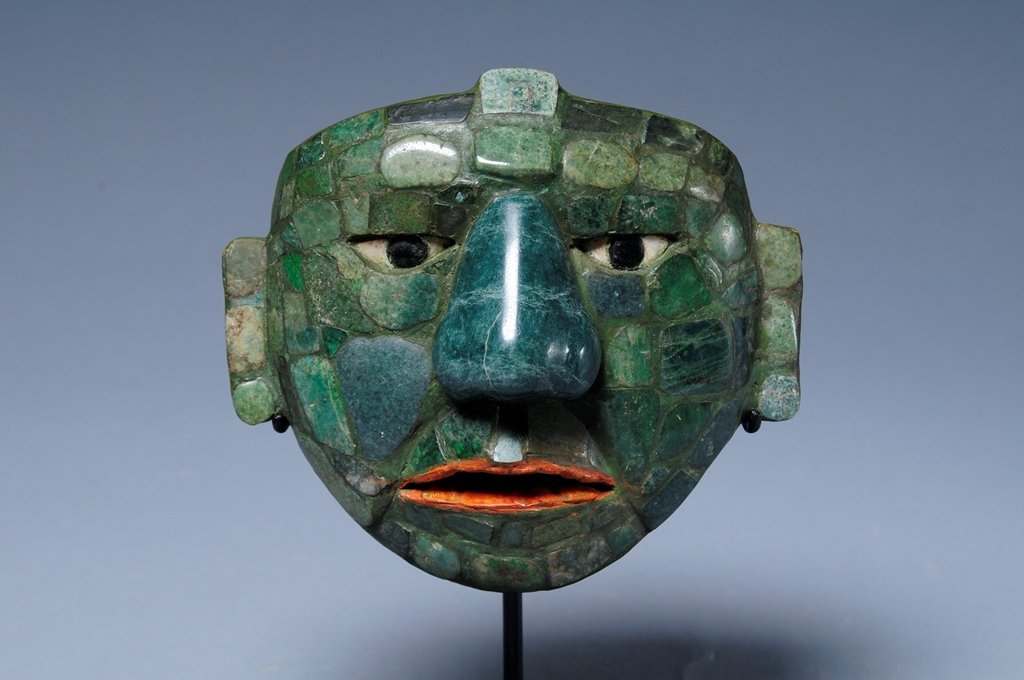
Mask with mosaics of jade, shell and obsidian
01 Photograph Gallery

02 Object Information
- Description
Description
Anthropomorphic mosaic mask with jade pieces for the face; Spondylus princeps shell and coral for the lips; and eyes inlaid with shell and obsidian. Its size suggests it may have been a royal belt ornament or a pectoral.
The Maya were masters in the creation and manufacture of masks from various materials, especially jade. The smaller ones, like this one, were usually mounted on wood and could have been used as large pectorals and ornaments for royal belts.
Additional Information
* This mask was displayed in fragments at the Príncipe Maya Museum in Cobán (Alta Verapaz) until the collection was donated to the La Ruta Maya Foundation in October 2010.
* It was restored from a handful of small pieces of jade, coral, and shell. The mosaic fragments were registered in April 2008 under No. 16.2.5.1161 by the Cultural Property Register (IDAEH), which placed the number behind the piece identified as the nose.
* The jade mosaics were repositioned and adhered to a resin base, making the restoration completely reversible. All the pieces fit together perfectly and correspond to the mask, making it a piece with 100% integrity.
* It contains fragments of Spondylus princeps. Pacific Ocean. Non-CITES Listed for Central America (ID: Archaeologist Julio Cotom, 2016).
- Period
- CLASSIC (150/200 A.D.-900 A.D.) Late Classic (650-900 AD).
- Provenance
- Maya Lowlands
- Medium / Material
- Coral, Jade / Jadeite, Obsidian, Shell
- Technique
- Appliqué / application, Inlaid, percussion, Polished, Worked
- Dimensions
Height: 12.4 cm
Width: 13.7 cm
03 References and Exhibitions
- References to similar objects
Jadeite Mosaic Masks in Classic Maya Culture
(Dorie Reents-Budet and Sofía Paredes Maury, 2025)Jadeite mosaic masks were worn exclusively by the highest-ranking members of Classic Maya society (250–850 CE). These masks had ceremonial and symbolic functions: some were placed in royal burials, while others were worn as part of elaborate belts or pectorals by both men and women. Pectoral masks were usually smaller than belt masks.
These masks often represented deities or revered ancestors, serving as powerful symbols of divine authority. In a world where rulers constantly had to reaffirm their legitimacy—both among rival city-states and in the spiritual realm—these adornments played a key role in expressing their sacred connection to the gods.
Crafted by highly skilled artisans, the masks were made from polished jadeite—especially the finest green varieties sourced from southern Guatemala. Other materials like obsidian, conch shell, and the vivid red Spondylus shell from the Pacific were used to highlight features such as eyes and lips.
The mosaic pieces were originally mounted on wood or a papier-mâché-like base, which rarely survives the humid conditions of the Maya lowlands. As a result, many masks are found as scattered fragments that require careful restoration to reconstruct their original form.
Jadeite was not only prized for its beauty and rarity but also for its deep spiritual meaning. In many Mayan languages, the word yax refers to both green and blue—colors associated with water, fertility, and maize, the sacred crop that sustained life. These associations made jadeite the most precious material in ancient Mesoamerica.
As royal emblems, jadeite masks symbolized the ruler’s divine connection to the Maize God, reinforcing their power and legitimacy through cosmological beliefs.
To read more:
Gallegos Gómora, Miriam Judith y Ricardo Armijo Torres. 2004. “Rostros Mayas de Jade (mini-guía)“. CONACULTA-INAH. Instituto Nacional de Antropología e Historia, Mexico. (documento en PDF)
García Vierna, Valeria A. 2004. “¿Máscaras para la Vida o para la Muerte? Una reflexión sobre la función de las máscaras de mosaico de jadeíta en el Área Maya“. Texto presentado como finalista para el Premio Palenque publicado en la Memoria de la IV Mesa Redonda de Palenque. INAH-CNCA. 70-86 pp.
- Exhibitions
1. “THE WORLD OF THE MAYAN ARTIST.” Spanish Cooperation Training Center. Antigua Guatemala (February 3 – June 16, 2013)
2. “THE WORLD OF THE MAYAN ARTIST.” Casa N’oj Cultural Center, Quetzaltenango (August 12 – September 6, 2013)
3. “TREASURES OF THE MAYAN SPIRIT” LA Art & Antique Show. LA Convention Center, California (January 4–9, 2014)
4. “TREASURES OF THE MAYAN SPIRIT” Interbanco Art Gallery, Quetzaltenango (September 8 – November 10, 2014)
5. “TREASURES OF THE MAYA SPIRIT THROUGH TIME.” ARTECENTRO Graciela Andrade de Paiz, Historic Center, Guatemala City (May 21 – October 19, 2015)
6. “MAYA: RULERS OF THE RAINFOREST”
Drents Museum, Assen, Netherlands (February 28 – September 4, 2016)
Historisches Museum der Pfalz, Speyer, Germany (October 2, 2016 – April 23, 2018)
Archaeological Museum of Alicante, MARQ, Spain (May 25, 2017 – January 7, 2018)7. “MAYAS IN SANTO DOMINGO DEL CERRO.” Santo Domingo del Cerro Cultural Center, Antigua Guatemala (August 16, 2018- April 20, 2019)
8. “MAYA: THE GREAT JAGUAR RISES” (1st. Tour) Canada and United States (May 15, 2019- October 20, 2021)
9. “MAYA: THE GREAT JAGUAR RISES” (2nd. Tour) Kansas City Union Station (August 2022-March, 2023) and California Science Center (April-September, 2023)
10. “MASTERWORKS BY THE PRE-COLUMBIAN ARTIST.” La Ruta Maya Foundation, Guatemala City (November 6, 2024 to May 31st, 2025)
- Publications
1. “Presentan el Mundo del Artista Maya” Diario El Quetzalteco. “. Miércoles 14 de agosto 2013. Página 11.
2. “Cultura Prehispánica Resplandece”. Sección Cultura. Prensa Libre. Martes 5 febrero 2013. Página 46.
3. “Mirada al Artista Maya”. Diario El Periódico. Lunes 11 febrero 2013.
4. Revista Aniversario XV del El Periódico. “El Nacimiento del Museo Maya de América“. Noviembre 2011.
5. “Treasures of The Maya Spirit”. IMS Explorer. Institute of Maya Studies. Julio 16, 2014. Página 2.


