
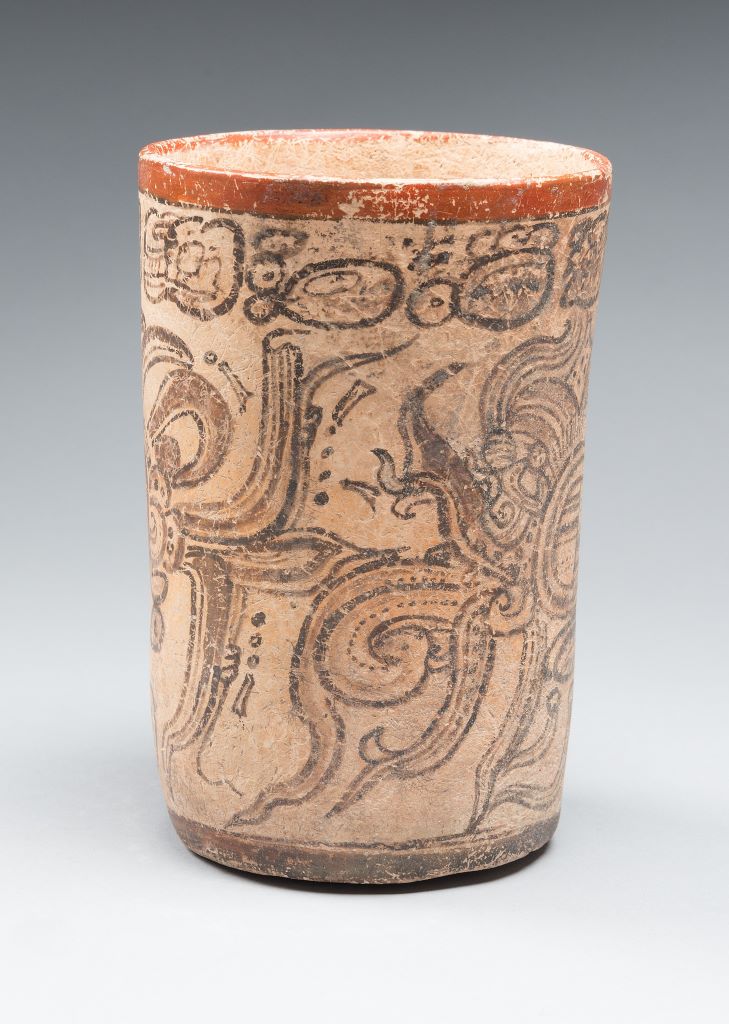
Codex-style vase with Zoomorphs of the Underworld
01 Photograph Gallery
02 Object Information
- Description
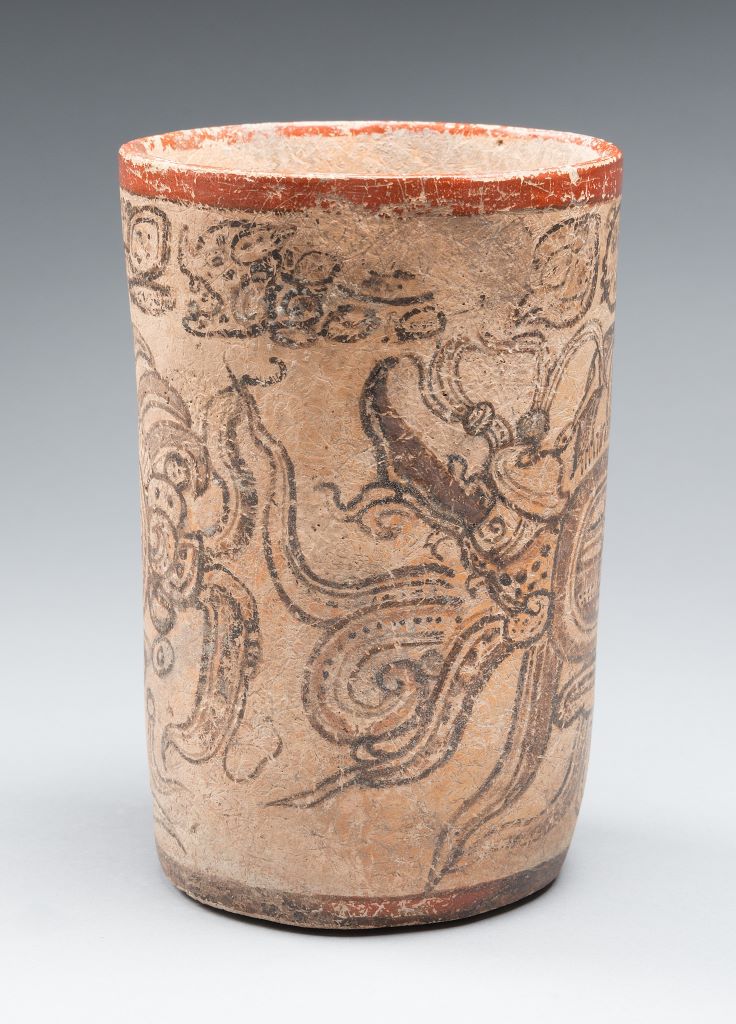
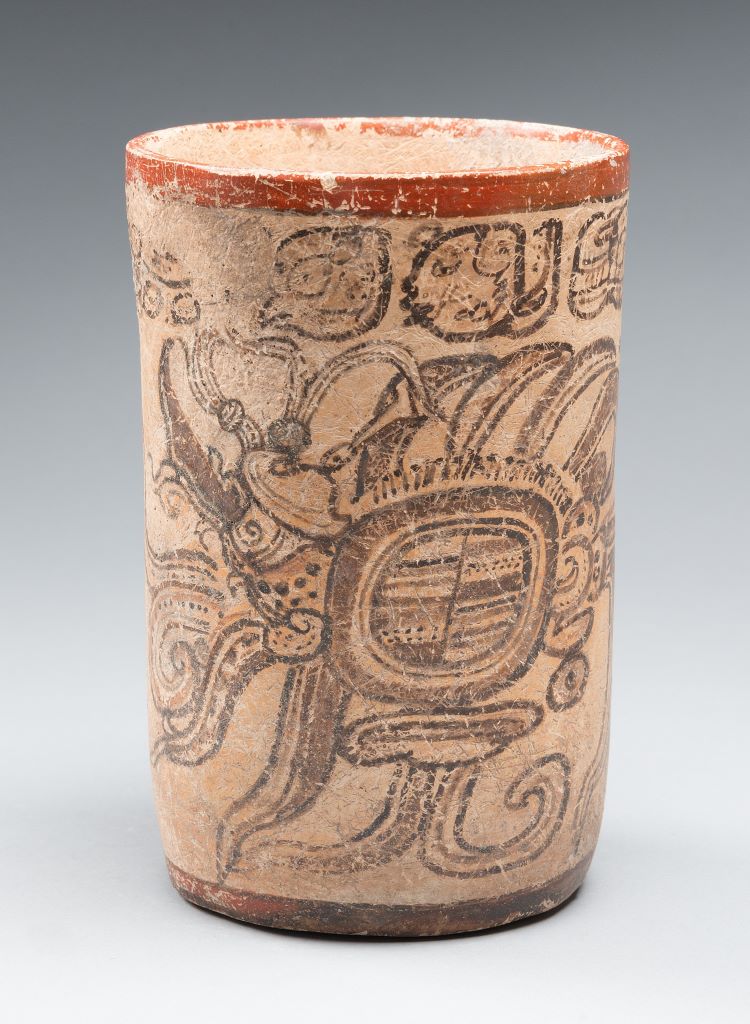
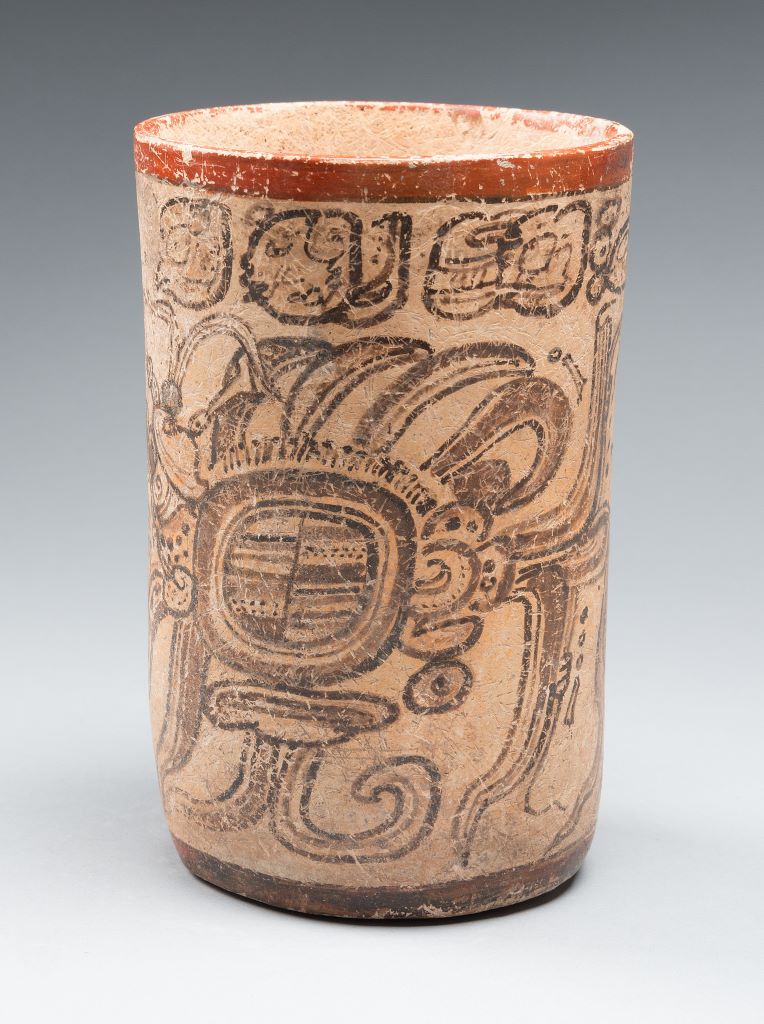
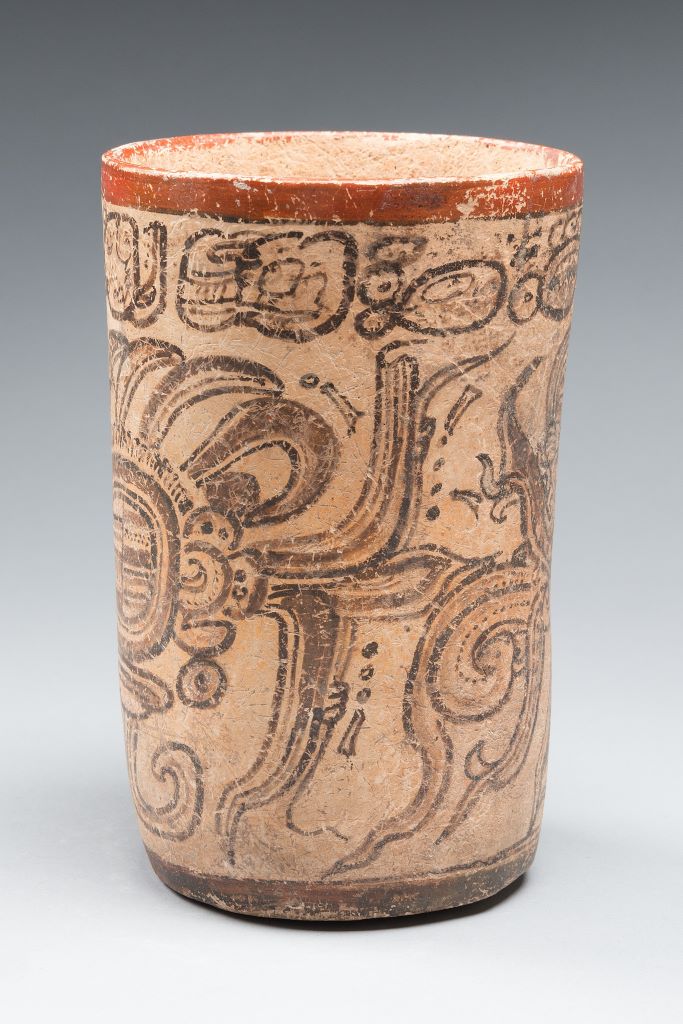
Codex-style kakaw drinking vase, decorated with two supernatural zoomorphs, on opposite sides of the vessel, which could be fish or birds of the underworld, with stylized features of both.
The figures, outlined in brown on a cream background, have round bodies divided into four brown-and-cream sections. Other stylized features include the oversized mouth or beak, feathers, scrolls, and supernatural eyes.
A horizontal glyphic band below the rim (Primary Standard Sequence or Dedicatory Formula) indicates that it is a kakaw (cocoa) drinking vessel.
The vessel has the horizontal red bands that frame the scene and characterize Codex-style vessels.
- Period
- CLASSIC (150/200 A.D.-900 A.D.) Late Classic (650-900 AD).
- Provenance
- Maya Lowlands
- Medium / Material
- Clay
- Technique
- Modeled, Painting, Slip
- Dimensions
Height: 15.9 cm
Diameter: 10.3 cm
03 References and Exhibitions
- References to similar objects
Codex style pottery is an outstanding example of ceramic pictorial art
The ceramics of this style stand out for the delicate calligraphic stroke of the line, which highlights the artist’s mastery. The vessels of this style have a red rim and complex scenes executed with a thin black or brown line on a cream background, highlighting the finely executed hieroglyphic texts.
Its manufacturing and distribution region, between the years 672-751 AD, was the north of Petén, around El Mirador and Calakmul. Several examples have been found in other places, such as La Muerta, El Tintal, Nakbé, El Porvenir and Zacatal.Its name comes from its resemblance to the colors and decoration of the Mayan codices, the folding books made with the bark paper of amate tree and it was given by archaeologist Michael Coe, author of the book “The Maya Scribe and his World” (1973).
- Exhibitions
Vase exhibited at the Príncipe Maya Museum (Cobán, Alta Verapaz) until the collection was transferred to La Ruta Maya Foundation in October 2010.
1. “TREASURES OF LA RUTA MAYA.” Quiroa gallery, Paseo de los Museos, Hotel Casa Santo Domingo, Antigua Guatemala (August 30 – November 9, 2014)
2. “MASTERWORKS BY THE PRE-COLUMBIAN ARTIST.” La Ruta Maya Foundation, Guatemala City (November 6, 2024 to May 31st, 2025)
- Publications
Baron, Joanne. 2024. “Classic Maya Wahys: What, Who, Where, and Why?”
Society for American Archaeology 89th Annual Meeting, New Orleans, LA.Boucher Le Landais, Sylviane. 2014. “Vasijas estilo códice de Calakmul. Narraciones mitológicas y contextos arqueológicos” en Arqueología Mexicana, Ed. Raíces S.A de C.V., Vol. XXII, No. 128. Julio-agosto 2014, pp. 58 – 65.
Freidel, David; Linda Schele y Joy Parke. 1999. “El Cosmos Maya. Tres mil años por la senda de los chamanes”. Fondo de Cultura Económica, México. p. 87.
García Barrios, Ana. 2011. “Análisis iconográfico preliminar de fragmentos de vasijas estilo códice procedentes de Calakmul” en Estudios de Cultura Maya, UNAM-IIFL-CEM, vol. XXXVII. p. 78.
Reents-Budet, Dorie J. 1994. “Painting the Maya Universe: Royal ceramics of the classic period”. Duke University Press, Durham and London. Pág. 280
Stuart, David. October 26, 2012. “Maya Spooks” in MAYA DESCIPHERMENT. Online https://mayadecipherment.com/2012/10/26/maya-spooks/
Excerpt from: David Stuart, 2005. Glyphs on Pots: Decoding Classic Maya Ceramics, Sourcebook for the 2005 Maya Meetings at Texas, Department of Art and Art History, UT-Austin, Austin.Velásquez García, Erik. 2009. “Algunas reflexiones sobre el estilo códice y el vaso de Princeton” en Pari Journal, vol. X no.1, 2009, p. 3. Online: http://www.mesoweb.com/pari/journal/archive/PARI1001.pdf
Velásquez García, Erik. 2020. “New Ideas about the Wahyis Spirits Painted on Maya Vessels: Sorcery, Maladies, and Dream Feasts in Prehispanic Art”. The PARI Journal 20 (4): 15-28 © 2020 Ancient Cultures Institute. Online: https://www.mesoweb.com/pari/publications/journal/2004/Wahyis.pdf


