
Codex Vase with Monkey and Turkey
01 Photograph Gallery

02 Object Information
- Description
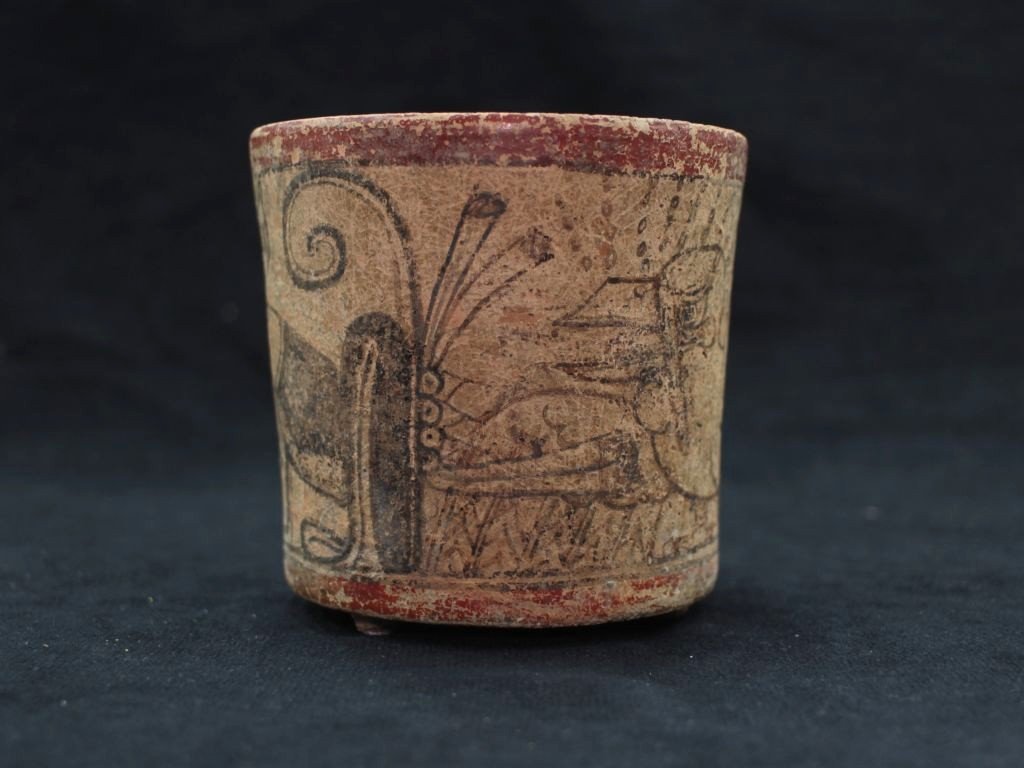
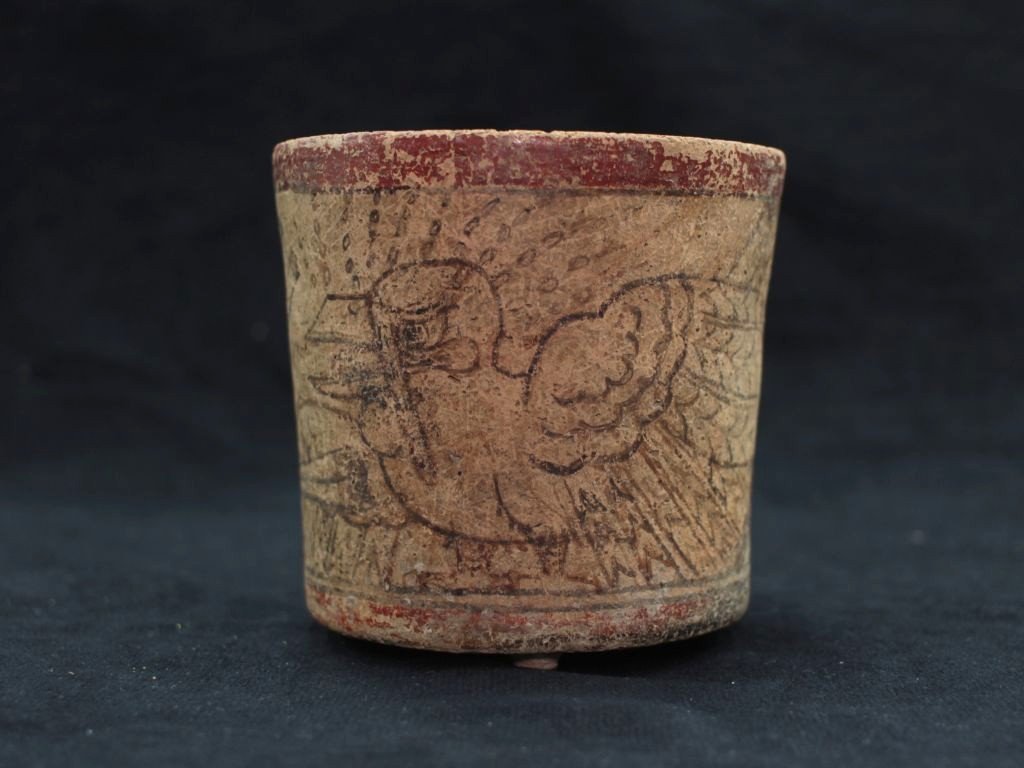
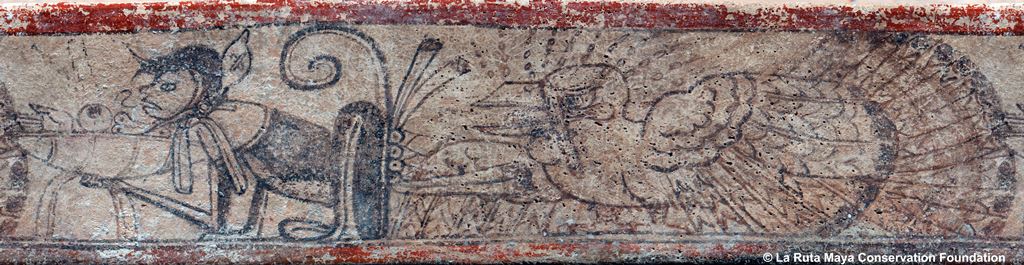
Codex-style polychrome (red and black on white background) tripod vase, decorated with an underworld scene.
The black-on-cream painted scene shows the image of a spider monkey, in left profile, wearing a piece of cloth over its shoulders formerly known as a “sacrificial scarf” but now associated with the supernatural characters known as wahy [way or waay]. The monkey has a deer’s ear and a curled tail. In one of its hands he holds what is known as a “triadic plate” containing a severed hand, a nucleated eye and a femur.
On the opposite side of the vase is the image of an oscellated turkey (Meleagris ocellata) in left profile, standing with spread wings and tail. The legs, eye and open beak are clearly depicted. A series of curved, dotted lines painted above the bird’s head seem to indicate that the turkey is in motion, perhaps dancing.
The scene is framed by two horizontal red bands, one above and below the lip of the vase and the other on the lower edge of the wall.
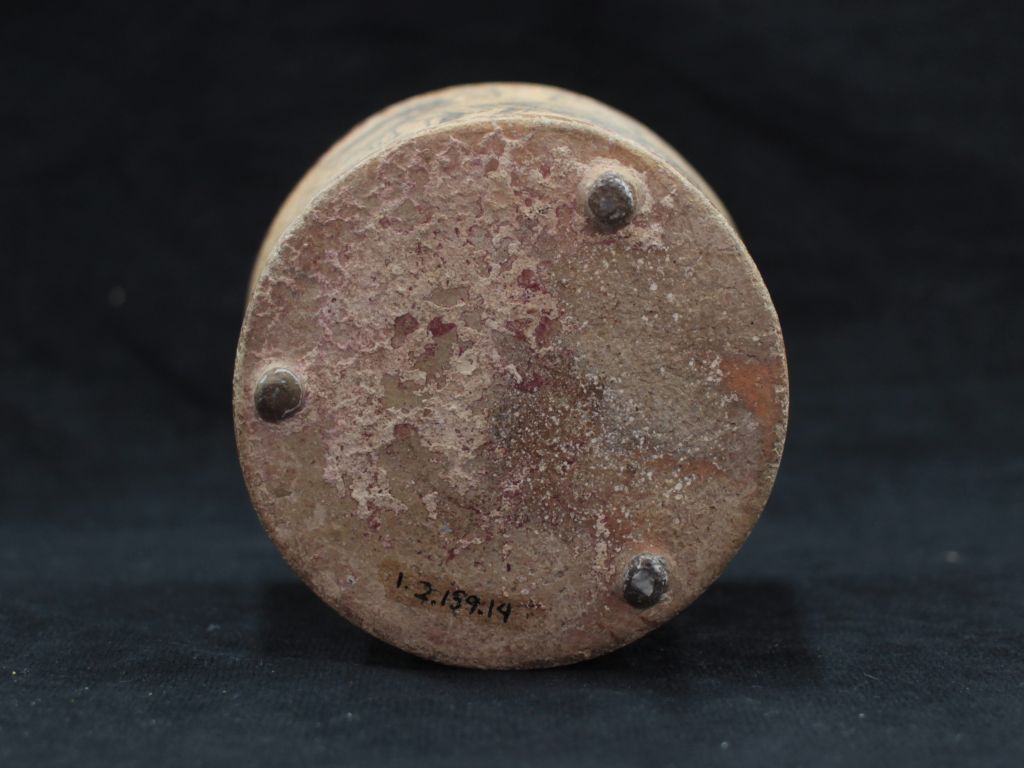
The vase has a outflared wall, rounded lip, flat bottom and button-shaped supports.
- Period
- CLASSIC (150/200 A.D.-900 A.D.) Late Classic (650-900 AD).
- Provenance
- Maya Lowlands
- Medium / Material
- Clay
- Technique
- Modeled, Painting, Slip
- Dimensions
Height: 11 cm
Diameter: 11.5 cm
03 References and Exhibitions
- References to similar objects
The ceramics of this style stand out for the delicate calligraphic stroke of the line, which highlights the artist’s mastery. The vessels of this style have a red rim and complex scenes executed with a thin black or brown line on a cream background, highlighting the finely executed hieroglyphic texts.
Its manufacturing and distribution region, between the years 672-751 AD, was the north of Petén, around El Mirador and Calakmul. Several examples have been found in other places, such as La Muerta, El Tintal, Nakbé, El Porvenir and Zacatal.
Its name comes from its resemblance to the colors and decoration of the Mayan codices, the folding books made with the bark paper of amate tree and it was given by archaeologist Michael Coe, author of the book “The Maya Scribe and his World” (1973).
To read more:
Baron, Joanne. 2024. “Classic Maya Wahys: What, Who, Where, and Why?”. Society for American Archaeology 89th Annual Meeting, New Orleans, LA (2024)
Boucher Le Landais, Sylviane. 2014. “Vasijas estilo códice de Calakmul. Narraciones mitológicas y contextos arqueológicos” en Arqueología Mexicana, Ed. Raíces S.A de C.V., Vol. XXII, No. 128. Julio-Agosto 2014, pp. 58 – 65.
Freidel, David; Linda Schele y Joy Parke. 1999. “El Cosmos Maya. Tres mil años por la senda de los chamanes“. Fondo de Cultura Económica, México. p. 87.
García Barrios, Ana. 2011. “Análisis iconográfico preliminar de fragmentos de vasijas estilo códice procedentes de Calakmul” en Estudios de Cultura Maya, UNAM-IIFL-CEM, vol. XXXVII. p. 78.
Reents-Budet, Dorie J. 1994. “Painting the Maya Universe: Royal ceramics of the classic period”. Duke University Press, Durham and London. Pág. 280
Stuart, David. October 26, 2012. “Maya Spooks” in MAYA DECIPHERMENT. Online https://mayadecipherment.com/2012/10/26/maya-spooks/
Excerpt from: David Stuart, 2005. Glyphs on Pots: Decoding Classic Maya Ceramics, Sourcebook for the 2005 Maya Meetings at Texas, Department of Art and Art History, UT-Austin, Austin.Velásquez García, Erik. 2009. “Algunas reflexiones sobre el estilo códice y el vaso de Princeton” en Pari Journal, vol. X no.1, 2009, p. 3.
Online: http://www.mesoweb.com/pari/journal/archive/PARI1001.pdfVelásquez García, Erik. 2020. “New Ideas about the Wahyis Spirits Painted on Maya Vessels: Sorcery, Maladies, and Dream Feasts in Prehispanic Art”. The PARI Journal 20 (4): 15-28 © 2020 Ancient Cultures Institute.
Online: https://www.mesoweb.com/pari/publications/journal/2004/Wahyis.pdf- Exhibitions
1. Financiera de Occidente (October 2010 – April 2011)
2. “MAYA, FROM DAWN TO DUSK” (MAYA de l’aube au crépuscule). Musée du quai Branly in Paris, France (June 21 – October 2, 2011)
3. “THE WORLD OF THE MAYAN ARTIST.” Spanish Cooperation Training Center. Antigua Guatemala (February 3 – June 16, 2013)
4. “THE WORLD OF THE MAYAN ARTIST.” Casa N’oj Cultural Center, Quetzaltenango (August 12- September 6, 2013).
5. “TREASURES OF THE MAYA SPIRIT”. LA Art & Antique Show. LA Convention Center, California (January 4-9, 2014)
6. “TREASURES OF LA RUTA MAYA”. Quiroa Gallery, Museum Walk, Casa Santo Domingo Hotel. Antigua Guatemala (August 30 – November 9, 2014)
7. “MAYA: RULERS OF THE RAINFOREST”
Drents Museum, Assen, Netherlands (February 28- September 4, 2016)
Historisches Museum der Pfalz, Speyer, Germany (October 2, 2016- April 23, 2018)
Alicante Archaeological Museum, MARQ, Spain (May 25, 2017-January 7, 2018)8. “MAYAS IN SANTO DOMINGO DEL CERRO”. Santo Domingo del Cerro Cultural Center, Antigua Guatemala (August 16, 2018- April 20, 2019)
9. “MASTERWORKS BY THE PRE-COLUMBIAN ARTIST.” Santo Domingo del Cerro Cultural Center, Antigua Guatemala (December 2019 to February 2, 2022)
10. “MASTERWORKS BY THE PRE-COLUMBIAN ARTIST.” La Ruta Maya Foundation, Guatemala City (November 6, 2024 to May 31st, 2025)
- Publications
1. “Presentation of the World of the Mayan Artist.” El Quezalteco newspaper. Wednesday, August 14, 2013. Page 11.
2. “Pre-Hispanic Culture Shines” in the Cultural section of Prensa Libre. Tuesday February 5, 2013. Page 46.
3. “A Look at the Mayan Artist” in El Periódico newspaper. Monday February 11, 2013.
4. Magazine. MAYA from l’aube au crépuscule. Connaissance des Arts, No. 497. 2011. Page 34. Paris, France.
5. Exhibition catalog of MAYA l’aube au crépuscule. 2011. Page 201. Paris.
6. Paredes Maury, Sofia. January 2015. “The Monkey and the Ancient Mayans”. PubliRuta Magazine (6th edition). National Radio Consortium, CRN. Guatemala. p. 6 and 7)


