
Códex style vase with Huunal heads (Tunesi Vase)
01 Photograph Gallery
02 Object Information
- Description
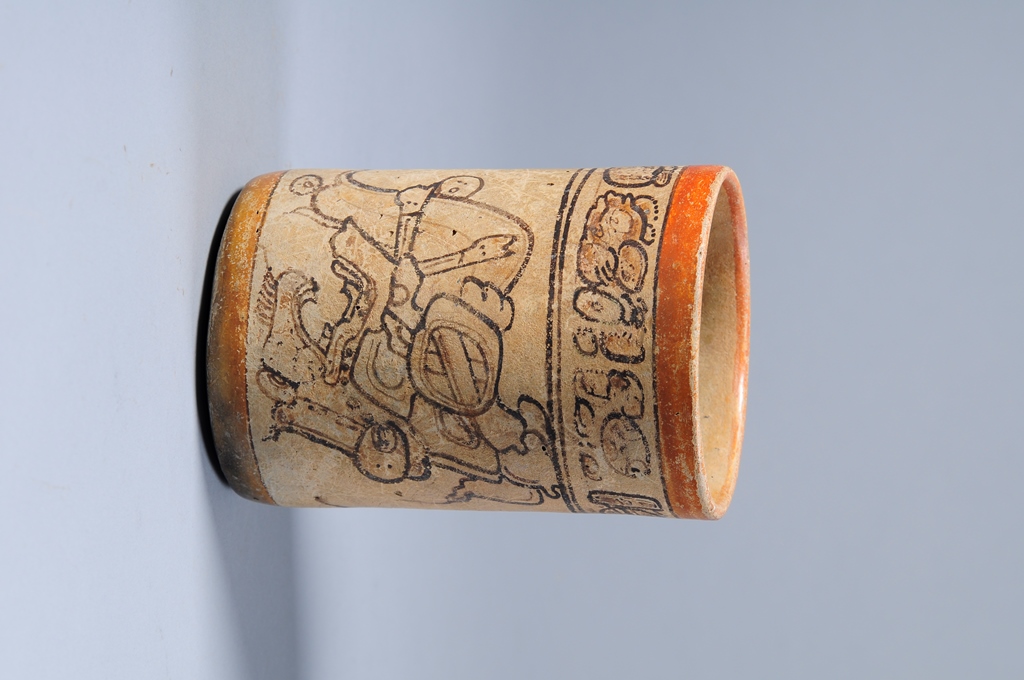
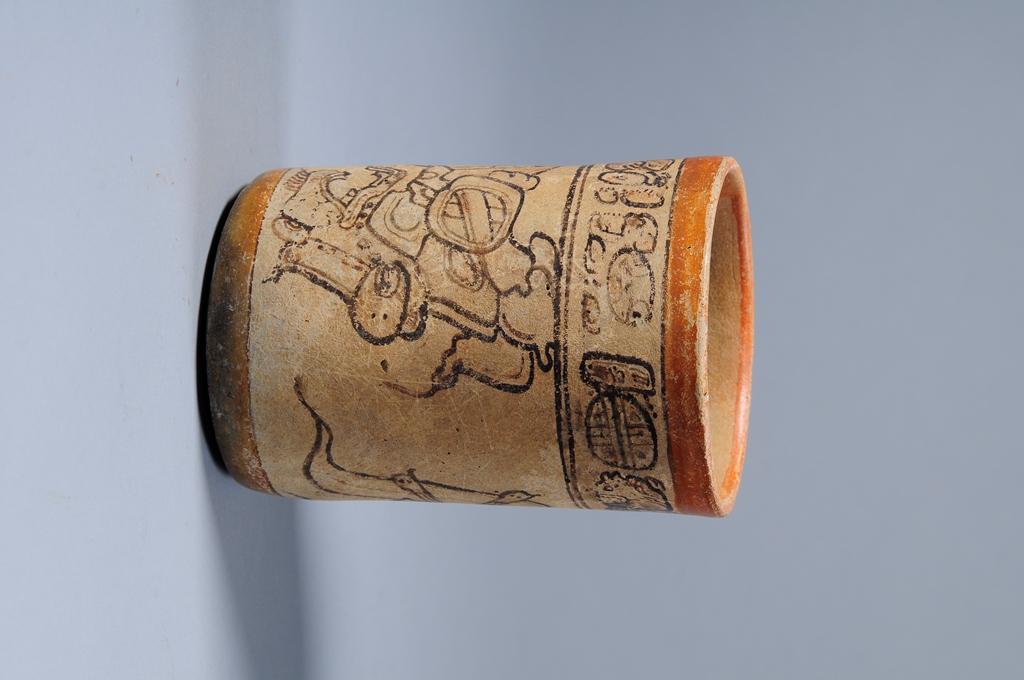
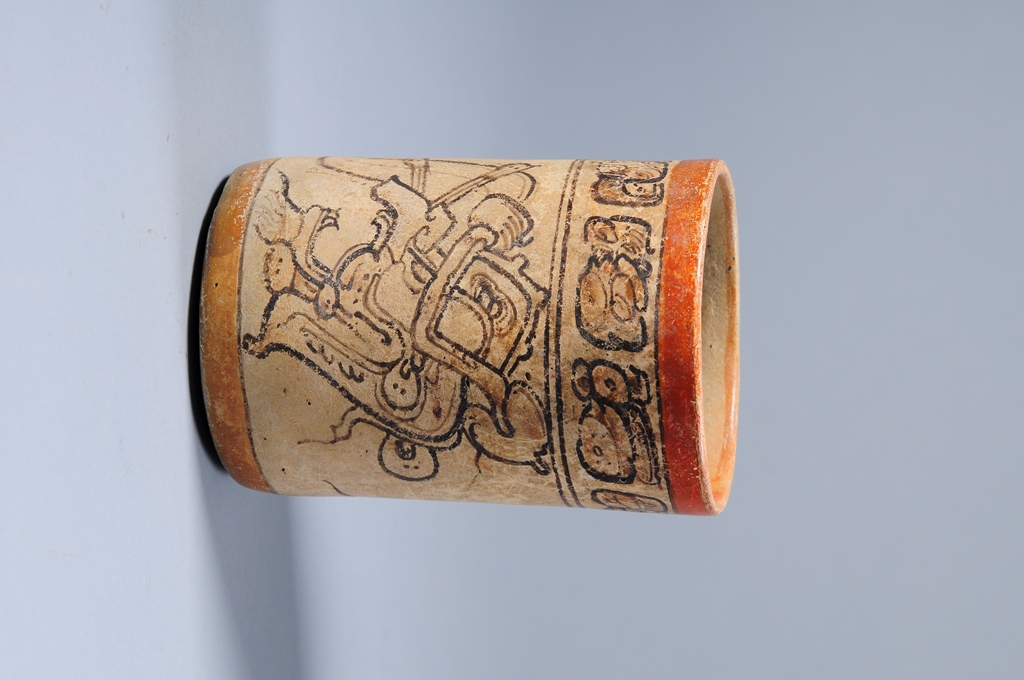
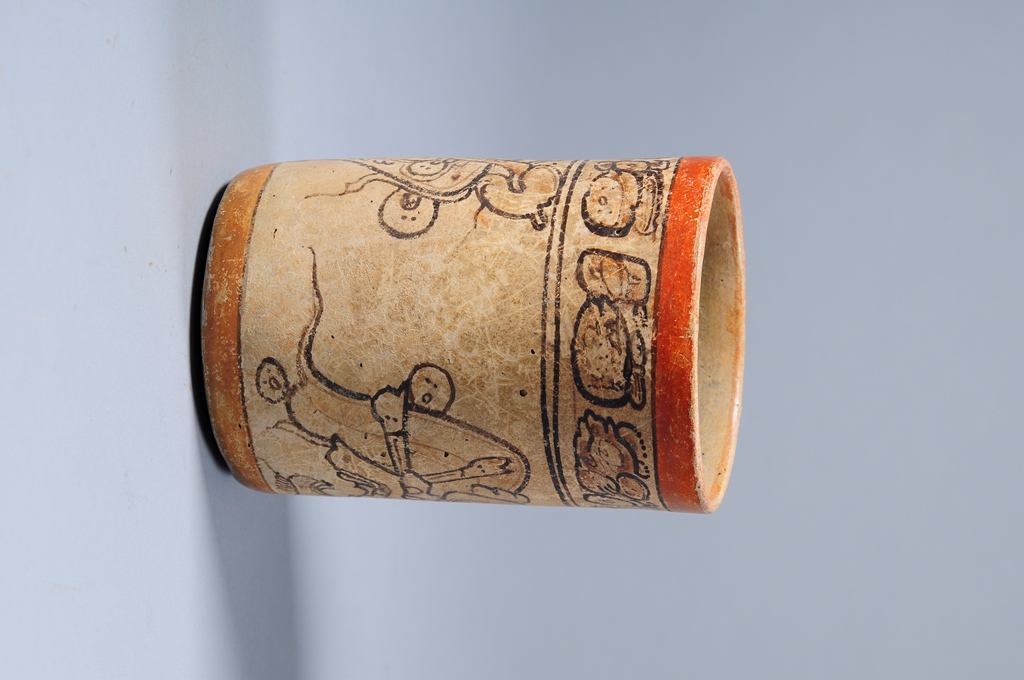
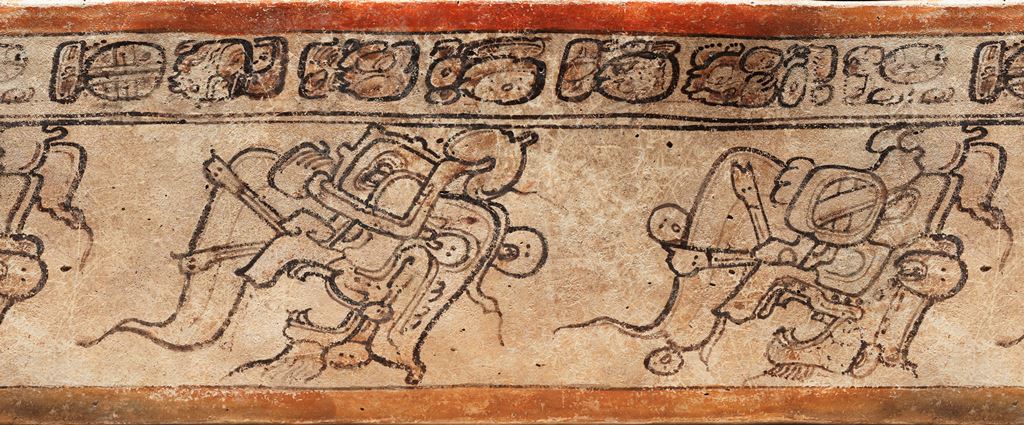
“Codex style” vessel decorated with a horizontal hieroglyphic text (Standard Primary Sequence PSS or dedicatory formula).
The wall is decorated with two Huunal heads in left profile, outlined in black on a cream background, placed on opposite sides of the vase. The scene is framed by horizontal red bands and black lines, on and below the lip of the vase and in the lower edge of the wall.
Vase has a straight wall, rounded lip and flat bottom.
* The neutron activation analysis of the paste indicates its probable manufacture origin in the Maya Lowlands, probably Tintal, south of El Mirador and the Calakmul Plateau.
* This vase is named after Raphael Tunesi as a tribute to his memory, after his fateful death on Friday, July 1, 2022. He helped identify the vase as the work of Master 3 of Yopaat B’ahlam.
- Period
- CLASSIC (150/200 A.D.-900 A.D.) Late Classic (650-900 AD).
- Provenance
- Maya Lowlands
- Medium / Material
- Clay
- Technique
- Modeled, Painting, Slip
- Dimensions
Height:15 cm.
Diameter: 10 cm.
03 References and Exhibitions
- References to similar objects
Applying Morelli’s method, Antonio Aimi and Rafael Tunesi (2017) examined many of the most significant works of vascular painting within the linear style (a term they propose to separate them from the commonly known codex style), which allowed them to identify two macro schools: School of Weak [or Thin] Glyphs and School of Strong Glyphs.
With this they proposed, for the first time, specific attributions to identify certain artists, in particularly evident and precise cases, in the general form of the drawing, the details of the figures, the glyphs and their cartouches (if any).
This vase has been attributed to the Master 3 of Yopaat B’ahlam by Antonio Aimi and Raphael Tunesi (2017), within the School of Strong Glyphs, which is characterized by three elements:
1) the strong impact that glyphs and their sizes have on the painting;
2) a rigid layout on the surface that emphasizes the dedicatory formula (PSS) and a clear division between text and image;
3) the band of the Primary Standard Sequence (PSS) or Dedicatory Formula is imposed for its uniformity, strength and to mark that it is a separate element from the figures.
The characteristics of this artist form a set of personal and very peculiar features, which are present in all his works, especially in the glyphs. Several works that mention Yopaat B’ahlam mention him as coming from Chatahn, a place [or lieneage] frequently mentioned in linear-style vessels that are believed to be located in the current archaeological site of El Tintal. This Lord was the most important patron of vascular painting known to date, since Masters 1, 2 and 3 of Yopaat B’ahlam refer to him, in one way or another.
“Contrary to what some have suggested, the application of the Morelli method has proven its effectiveness also for Mayan art… with equal success, it can work in the negative when comparing drawings, iconography and similar, or equal themes. Hidden among common strokes, the personal differences of each hand come to manifest themselves. What at first glance may have seemed like slight variations of less importance, came to be confirmed as the key to the identification of each artist” (Aimi and Tunesi, 2017: 36).
- Exhibitions
1. “TREASURES OF THE MAYA SPIRIT”. LA Art & Antique Show. LA Convention Center, California (January 4-9, 2014)
2. “TREASURES OF THE MAYAN SPIRIT”. Interbanco Art Gallery, Quetzaltenango (September 8 – November 10, 2014)
3. “TREASURES OF THE MAYAN SPIRIT THROUGH TIME.” ARTECENTRO Graciela Andrade de Paiz, Historic District, Guatemala City (May 21 – October 19, 2015)
4. “MASTERWORKS BY THE PRE-COLUMBIAN ARTIST.” La Ruta Maya Foundation, Guatemala City (November 6, 2024 to May 31st, 2025)
- Publications
Aimi, Antonio y Raphael Tunesi. 2017. “Notes on some new great artists of the Holy Lords of Chatahn”. GLYPH DWELLERS. Report 54, May 2017.


